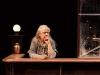
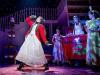
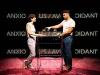
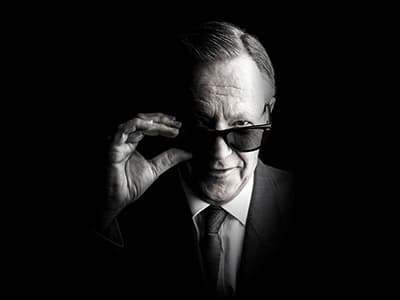
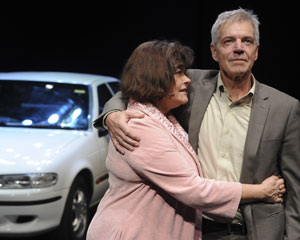
 Left – Genevieve Lemon and Colin Friels. Cover – Colin Friels. Photos – Heidrun Lohr
Driving 700 miles every week to make sales calls can be exhausting at the best of times, especially when you can't make enough money for the next instalment on the refrigerator. When you are 63 and your mind is starting to wander and you veer off the road, that is dangerous. And when the son you idolise hasn't lived up to your dreams of greatness, and he exposes you for the phoney that you are, that's a tragedy.
Arthur Miller's Pulitzer Prize winning play is not a tragedy about a character of heroic proportions, but a tragedy about a deluded, venal and ordinary man who shares one thing in common with many heroic tragic figures: the hubris that comes from false pride and the overestimation of his own worth.
Simon Stone's brilliant revival of this famous American classic fully realises the power of the play and makes it easily accessible to a contemporary audience. Stone's production has a very Australian sensibility to it. There is a stoicism running through the production that means it never becomes overly sentimental or overwrought. Colin Friels is compelling as Willy Loman, playing him like a little, wiry, pugnacious Aussie battler. And he does it with ferocious energy, fighting to maintain his delusion in every scene. Friels' Willy talks over other characters, tells them to be quiet, and abuses and threatens them to assert his fictional version of his life. Even in defeat, his Willy doesn't concede, he stays a fighter to the end.
Friels only ever allows glimpses of his character's frailty and, in not playing for pathos, makes Willy's desperation doubly heartfelt. I imagine Arthur Miller would be pleased with this characterisation as he worried about "too much identification with Willy, too much weeping, and that the play's ironies were being dimmed out by all this empathy". He should be pleased because it is a stunning performance.
Genevieve Lemon's Linda similarly draws on an Australian archetype: the phlegmatic, salt of the earth wife. Lemon contains Linda's emotions to the point of deadpan, and at the same time exudes a deep love for Willy. Exhibiting the necessary control and patience for coping with her husband, Lemon makes perfect sense of their relationship. Her portrayal ensures that Linda is not a victim. Her Linda has the insight that Willy lacks. She completely understands Willy and sees the good in him. Lemon's speech to her boys in the first act is one of two moments in the play in which Stone allows his actors to unleash their emotions: "I don't say he's a great man. Willy Loman never made a lot of money. His name was never in the paper. He's not the finest character that ever lived. But he's a human being, and a terrible thing is happening to him. So attention must be paid."
Abandoned by his father at an early age, Willy is emotionally rudderless and is desperate to mythologise his father and brother based on what little he knew of them. He constantly talks to his boys about the importance of standing, respect and success, but doesn't embody any of these values. The tragedy of the play is that Willy has constructed a life based on dishonesty and delusion. He is dishonest to himself and his family. What he teaches his boys is entitlement and deceit. He encourages them to steal from the building site, to cheat in maths tests, to think they are better than they are without having to work hard in order to achieve. They both end up as failures, but while Hap is determined to maintain the facade, Biff is destroyed by the knowledge that "we never told the truth for 10 minutes in this house" and what he grew up believing is a pack of lies.
Hamish Michael is very strong as the morally bankrupt Happy, spitefully competitive and blithely telling Willy whatever he wants to hear. Patrick Brammall is very impressive as Biff. He is equally good as the young, optimistic, all-American football star, still in his father's thrall, as he is in his heart breaking portrayal of the damaged and resentful adult Biff becomes.
The actors all use their own, mostly Australian, accents. Apart from Le Marquand, who plays Willy's brother Ben with an overly theatrical Aussie accent, the characters all sound natural and offer another point of identification for the audience.
While the current New York production has nostalgically replicated the original 1949 set, Ralph Myers has designed a bare stage adorned exclusively by a Ford Falcon. Alice Babidge's costumes are current, giving Stone's production a timelessness and underscoring the universality of the themes. Stone has brought the car onstage as a symbol of Willy's life on the road and inventively makes it central to the action. Without tables and chairs most of the scenes are delivered standing with others taking place inside the car which is ingeniously miked for sound. This works perfectly well except, perhaps, in the restaurant scene in which Biff and Hap abandon Willy and not having an empty table for Willy to return to lessens the impact of the scene.
There has been much discussion in the press about how the current financial problems brought about by the GFC makes the concerns of the play resonate for contemporary audiences. Those who have lost houses, stocks and careers might well feel they have worked their whole life to end up with nothing like Willy: "a hard-working drummer who landed in the ash-can like all the rest of them."
More than relating to a specific financial situation however, Death of a Salesman is a quintessential mid-life crisis play. Miller niggles at our fears: did our early expectations reconcile with achievements? Did we rise above mediocrity? Will we be remembered? Are we, like Willy and Biff, "a dime a dozen"?
Miller writes eloquently on the pitfalls of getting caught up in the need for material success that is at the heart of the American Dream. But it is the play's universal themes that gives Death of a Salesman its heft. The relationship between fathers and sons is what makes Miller's play so enduring. It is said that Elia Kazan was the first of many to tell Arthur Miller that Willy Loman was his father. Others apparently told him that Biff was their father. The dynamic in this family resonates, in varying degrees, as a universal concern. Simon Stone makes this idea central to his production and the emotional tug of war between Friels and Brammall makes for a very human interpretation.
In a society that judges success by wealth and status, Willy Loman is a complete failure. If he were to be judged on his integrity or insight, he would abjectly fail. But for all the damage his world of lies have done to his family, and despite their conflicted feelings towards him, Biff, Linda and Hap love him. Simon Stone changes the ending slightly and puts a strong emphasis on Willy's realisation of his son Biff's love for him. In this version, Willy is momentarily redeemed by that knowledge and can die knowing he was loved.
The New York Times describes the significant impact Elia Kazan's original 1949 production had on the audience. At the end of the show men were leaning forward with their heads in their hands openly weeping, seeing their own failed hopes and aspirations writ large. Death of a Salesman has the power to do that to an audience and it will very likely have a similar effect on audience members this time around.
Belvoir presents
Death of a Salesman
by Arthur Miller
Directed by Simon Stone
Venue: Belvoir St Theatre | 25 Belvoir St, Surry Hills
Dates: 23 June – 12 August, 2012
Times: Tuesday 6.30pm | Wednesday to Friday 8pm | Saturday 2pm & 8pm | Sunday 5pm
Tickets: Full $62 | Seniors (excluding Fri/Sat evenings) $52 | Concession $42
Bookings: 02 9699 3444 | www.belvoir.com.au